By Alan Ashley
You may have recently seen some strange vehicles on the streets of Chelsea, looking like they just came straight out the Disney/Pixar “Cars” movie. Since I’m a retired letter carrier who worked 30 years in Ann Arbor, I didn’t think there could be a better person to give you some background on this unique vehicle.
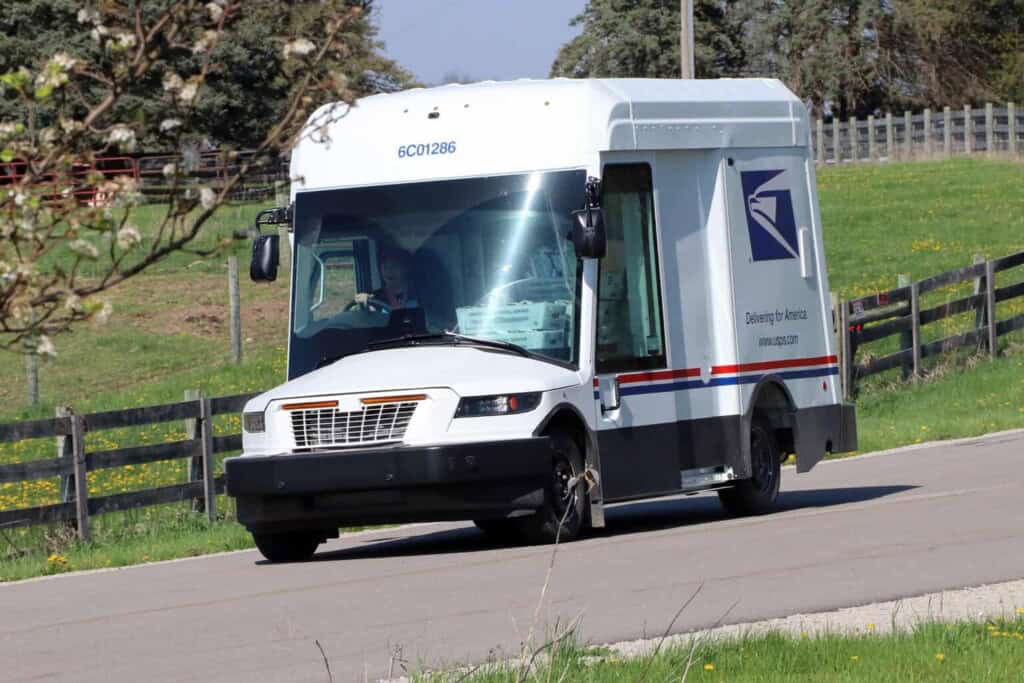
The United States Postal Service call the new vehicle New Generation Delivery Vehicle, or NGDV for short. It is designed to replace the Grumman LLV (Long Life Vehicle), which was produced from 1986-1994. It will also replace the Ford Utilimaster FFV (Flexible Fuel Vehicle), which was produced from 1999-2001. When I retired two years ago, I was driving a 34-year old LLV, which is still in use.
Back in 2015, the USPS started the process to develop a new vehicle. They, along with input from the letter carrier union, created a list of requirements for companies interested in making the vehicle. Carrier safety was top priority, looking to reduce injuries and deaths. You may be surprised to know that both the LLV and FFV do not have anti-lock brakes, airbags, or air conditioning. Another requirement involved a cargo area that allowed carriers to stand up and perform their duties. The LLV and FFV both are only about 4 feet in height in the cargo area. Two of the most common injuries letter carriers suffer are shoulder and back injuries, many times from loading or unloading mail in a hunched over position. But, one of the biggest improvements needed was reducing the blind spots in the vehicles. So, the extra-large windshield was made.
Six companies developed prototypes for testing. For the first time ever, letter carriers were able to field test the prototypes in 5 states, including Michigan (in Flint and Utica). Testing ended in 2019 and eventually Oshkosh Defense was awarded the contract in February, 2021. I would end up going down a “rabbit hole” if I went into the reasons for delays, but the NGDV went into production in 2024.
So, while the NGDV looks comical, weird, strange or another adjective, it was designed for function and carrier safety.